
How I Lost Weight On a High Carb Diet
These results may challenge everything you’ve been told about weight loss.

By: Jeremy Fox CNC, CPT
Updated: July 29, 2025

For years, I believed what most of the fitness world still preaches.
To optimize fat loss, you have to cut carbs.
Low-carb. No-carb. Keto. I tried them all.
And to be fair, those diets worked. I lost weight and even achieved single-digit body fat.
But deep down, I knew it wasn’t sustainable. And I never stuck with a low-carb diet longer than a few months.
Eventually, I questioned everything I’d been told about diet and fat loss.
What if, instead of reducing carbs, I increased them?
This is the story of how I broke free from the low-carb lifestyle and lost weight on a high-carb diet.
But first, let’s go back to the beginning.
My History With Low-Carb Diets
As a former physique competitor, I spent years following extreme low-carb diets to burn fat and prep for the stage.
Most of the time, that meant eating less than 100 grams of carbs a day. And as the contest approached, the daily carb count would often dip below 50 grams.

Photo of me dieting down to 150 pounds and very low body fat by restricting carbs.
To put that into perspective, a 2023 review of low-carbohydrate diets provided the following classification for carb intake.
Carbs As a Percent of Calorie Intake (g/2,000 calories):
- Very low-carb = under 10% (<50 g)
- Low-carb = 10–25% (50–125 g)
- Moderate-carb = 25–45% (125–225g)
- High-carb = 45% or more (>225g)
For me, the low-carb approach was effective. But there was a cost.
I often felt flat, both physically and mentally. The longer I went without carbs, the worse the issues became.
After a while, I saw noticeable dips in my weightlifting strength, cardio stamina, and day-to-day energy levels.
Additionally, the muscle I had worked so hard to build looked deflated and soft without carbs and glycogen to give it shape.
Over time, I experimented with moderate carb intakes. That led me to carb cycling. A more nuanced strategy that involves alternating between low, medium, and high carb days throughout the week, usually matched to your training intensity.
Cycling my carb intake helped me find a better balance. I could fuel my heavy workouts with high-carb days and still dip into fat stores on lower-carb recovery days.
It kept my metabolism from crashing and allowed me to hold onto more size and strength during cuts.
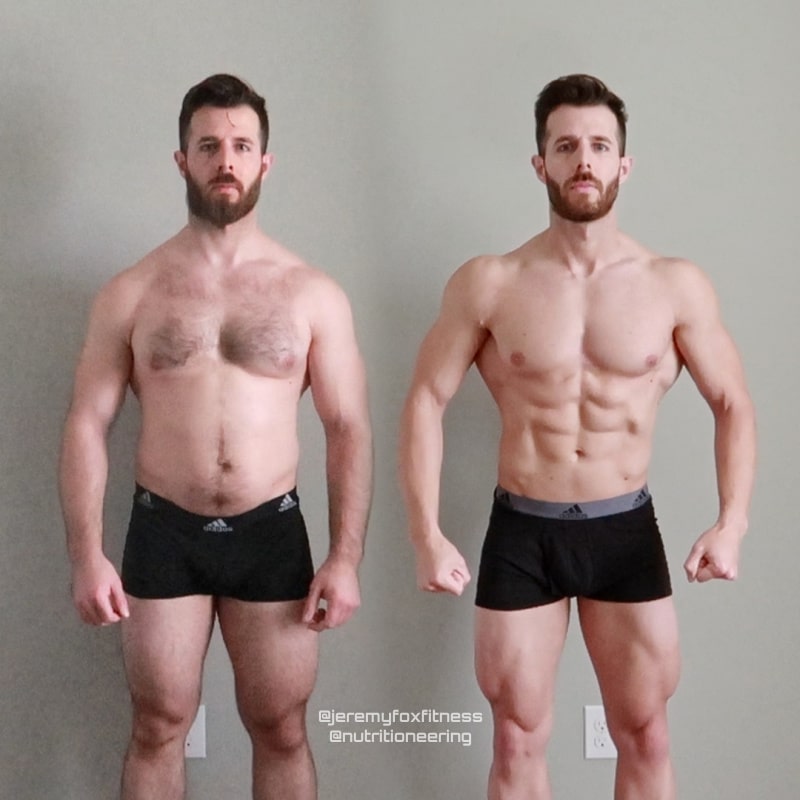
In this before and after picture, I used carb cycling to diet down from 196 lbs to 165 lbs.
But it was complicated. Carb cycling required meticulous planning, accurate macro tracking, and constantly adjusting targets based on my training schedule.
Why I Tried a High-Carb Diet
After years of alternating my carb intake, I realized that I was losing weight regardless of the grams I logged in MyFitnessPal.
I also noticed how much better I felt on high-carb days. My lifts were more intense, and my cardio pace was faster. The next morning, I often looked leaner, yet more muscular.
If more carbs made me look and feel my best, why was I limiting them?
I decided to commit to a continuous high-carb diet. Not to prove anything to anyone. Just to test the theory that I could lose body fat without cutting carbs and without losing muscle.
I started this experiment during a bulking phase, using fruits, veggies, rice, oats, potatoes, and bread to fuel my training and support muscle gain.

Finding My High Carb Targets
The first step of the high-carb weight loss diet was setting up a strategic calorie target.
I started by averaging out how many calories I typically burned each day using my Oura Ring’s activity tracking (which is surprisingly accurate). Then I set my target calorie intake slightly below that.
Calorie Determination:
- I burned 3,000 calories daily, on average
- I set my intake target at 2,700 calories
- That’s a 300 calorie deficit
This small 10% deficit was enough to drive fat loss without sacrificing performance or muscle mass.
Next came the macros. I built my plan around high-carbs and moderately high-protein.
Here are my macro percentages and the corresponding targets in grams.
Macro Targets Based on 2,700 Calories:
- 50–60% carbs = 340–405 grams
- 20–25% protein = 135–170 grams
- 20–25% fat = 60–75 grams
These ratios gave me plenty of carbs to fuel intense training, ample protein to preserve lean mass, and enough fat for proper hormone function.
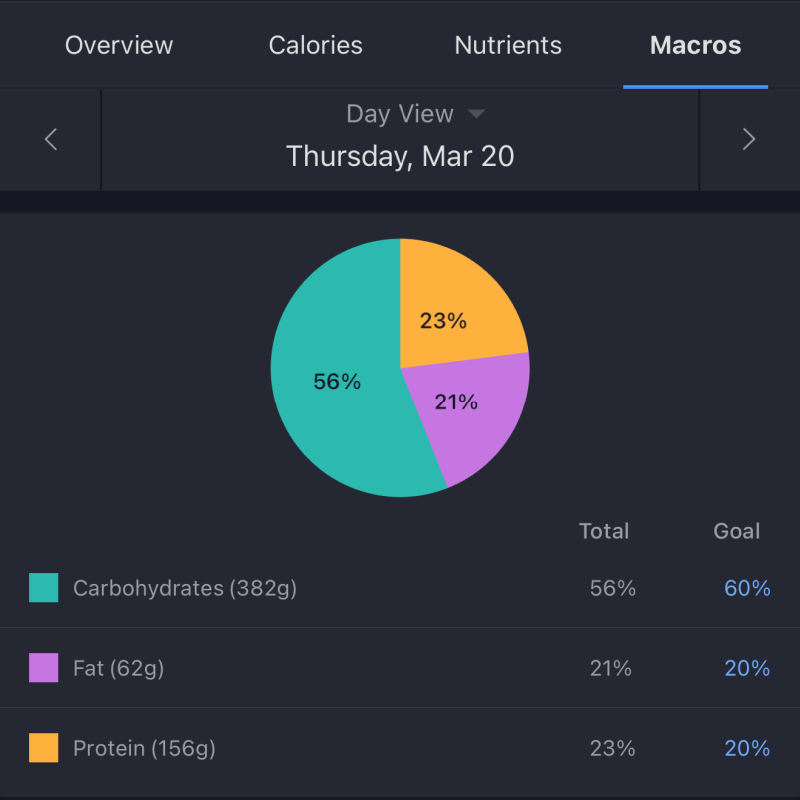
Screenshots from MyFitnessPal showing my macros for a typical day.
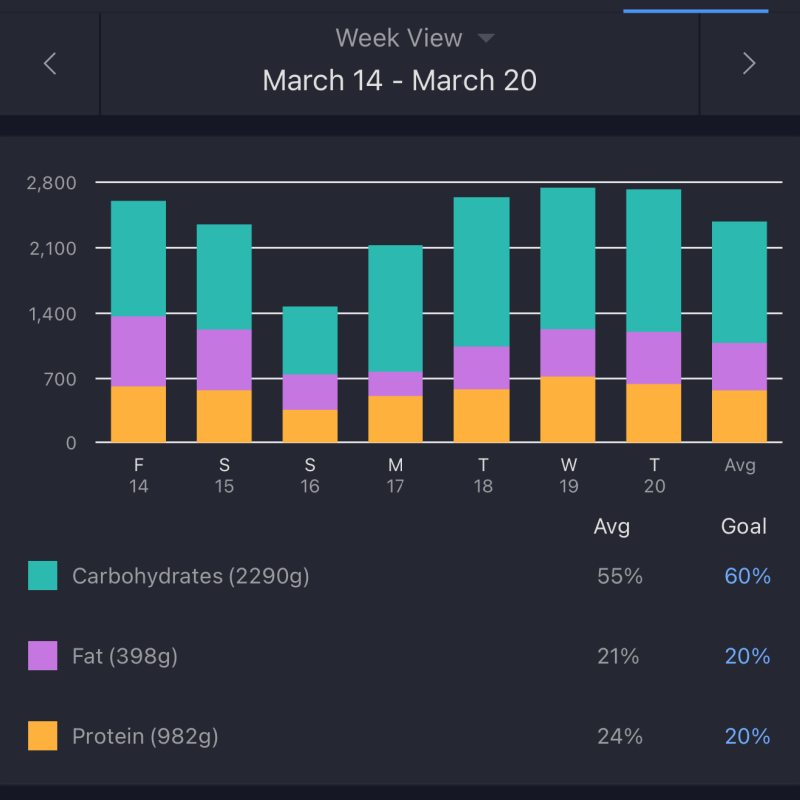
And my macro averages for the week.
What I Ate on a High-Carb Weight Loss Diet
Macro targets are just an empty latticework on which to build a diet. To make it come to life, you need to fill it with real foods and meals.
So I’m sharing an example of what a typical training day looked like on my high-carb meal plan.
Breakfast
- 2 slices whole wheat toast
- 2 tablespoons natural peanut butter
Lunch
- 4 oz grilled chicken breast
- ½ cup dry rice (cooked in bone broth)
- 1 cup steamed broccoli
Pre-Workout Meal
- 1 cup old-fashioned oats
- ⅔ cup whey protein powder (mixed in = “proats”)
Post-Workout Shake
- 1 cup frozen berries and mango
- ½ cup Greek yogurt
- ½ cup whey protein powder
- ¼ cup kale (blended in)
Dinner
- 3 oz ribeye steak
- 14 oz baked potato
- ½ cup grilled bell peppers
Evening Snack
- 1 oz pepitas (pumpkin seeds)

But the beauty of this approach wasn’t just in the added energy; it was the simplicity compared diets that involve carb cutting or carb cycling.
I could prep meals in bulk and eat the same thing every day. Or easily change things up since I was always targeting the same macronutrient ratio, whether it was a workout day or a rest day.
On rest days, I simply skipped the pre- and post-workout meals to match my lower energy needs and maintain the overall weekly deficit.
And once a week, I included a refeed day. On those days, I intentionally ate at or slightly above my maintenance level to prevent metabolic adaptation and weight loss plateaus.
My High Carb Results & Reflections
Over the next six months, I lost 12 pounds of almost pure body fat. Not just weight on the scale, but actual fat mass, confirmed by weekly body composition tracking.
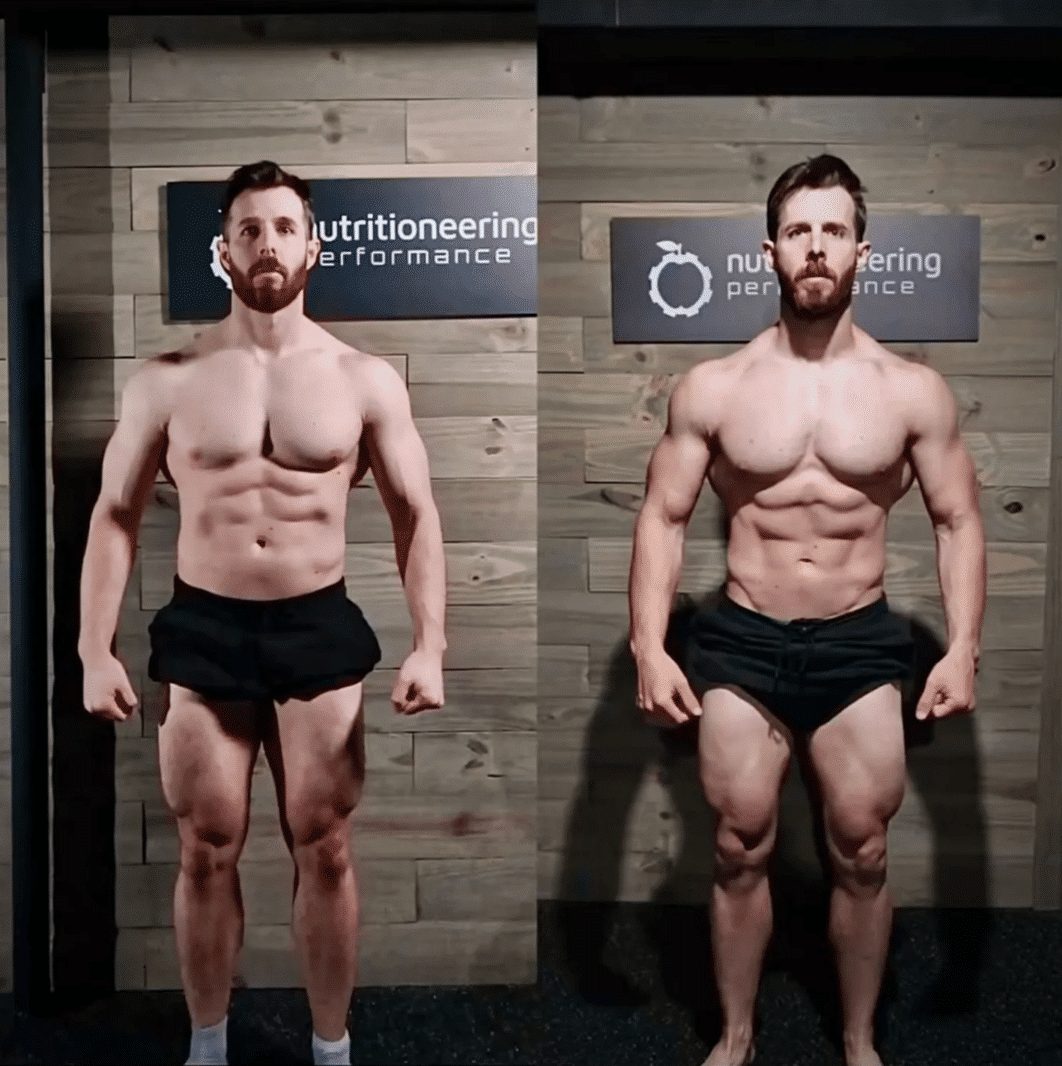
I cut down from 177 lbs to 165 lbs while eating nearly 400 grams of carbs per day.
However, I wasn’t trying to “drop 20 pounds in 30 days”. I was trying to get leaner without sacrificing performance or years of hard-earned muscle.
In fact, my workout log shows I maintained my numbers on squats, bench press, and pull-ups right through the end of the cut. You can see my actual numbers in this related story.
Contrast that with my past low-carb cuts, where I often lost 20–30% of my strength. Not to mention my physique flattened out like a leaky air mattress.
This time was different. I stayed full, energized, and consistent in the gym. My muscles looked pumped yet solid and defined. I wasn’t dragging through workouts or running on fumes at work. And that made all the difference — not just physically, but mentally.
This experiment proved to me:
- I didn’t have to cut carbs to lose fat.
- I didn’t have to sacrifice strength to get lean.
- I didn’t have to feel depleted to make progress.
These results fly in the face of the popular fitness dogma surrounding carbs and weight loss.
Am I an anomaly? Or does the fitness industry have it wrong?
Why Are Low-Carb Diets So Popular?
From Atkins to keto to carnivore, low-carb diets have gained cult-like status in some circles. And on the surface, it’s easy to see why.
Cutting carbs often leads to rapid weight loss. Sometimes several pounds in the first week. But here’s the catch: most of that initial drop isn’t fat — it’s water weight.
Carbs are stored in the body as glycogen, which binds to water at a ratio of about 1 gram of glycogen to 3–4 grams of water. So when you slash your carb intake, your body burns through glycogen and dumps the water along with it.
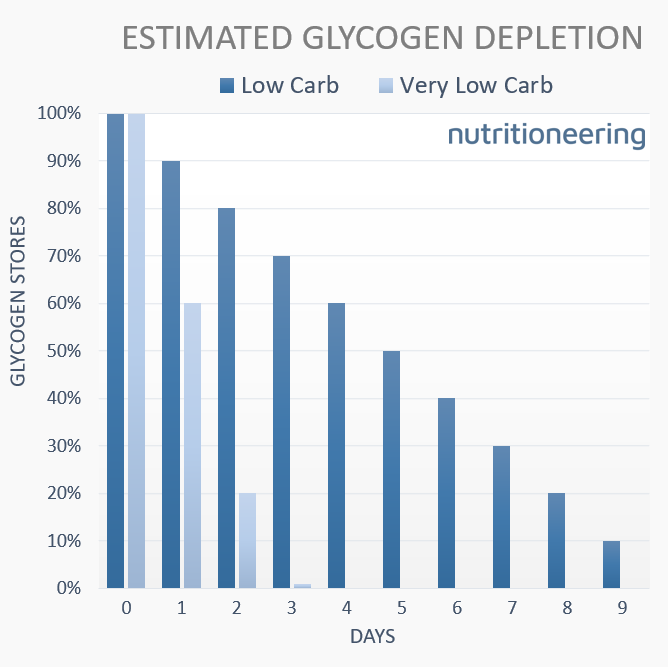
The number on the scale drops fast. And in a world obsessed with instant gratification, that feedback creates the illusion of results.
It’s an appealing narrative. “Carbs make you fat. Cut them out, and the fat will melt away.”
It’s simple. Easy to explain. And most importantly, it feels like it works better than other methods.
That’s why so many people (including younger me) jump on the low-carb bandwagon without asking questions. We latch on to the quick win and become emotionally invested in the idea that carbs are bad.
Before long, it’s more than a diet — it’s a belief system.
Energy levels dip. Strength declines. Cravings creep in. Adherence drops off.
Meanwhile, an increasing number of studies indicate that low-carb diets are not inherently superior for fat loss when calories and protein are matched. Yet, the myth persists largely because it’s ingrained in our minds.
That’s why my results might raise eyebrows and ruffle feathers. Losing body fat on a high-carb diet seems to go against everything we thought we knew about weight loss.
But in truth, I wasn’t breaking the rules. I was following the ones that actually matter: calorie balance, physical activity, and consistency.
The Science Behind High-Carb Weight Loss
Many people still believe that eating carbs automatically leads to fat storage. And that cutting carbs is the only way to burn fat effectively.
But recent research tells a different story.
Study #1: Low vs Medium vs High — No Long-Term Difference
A 2022 meta-analysis of 61 randomized controlled trials involving 6,925 participants compared low, moderate, and high-carb weight loss diets.
The results did not show a significant difference in weight loss after 1 to 2 years between diets of different carbohydrate intakes.
The researchers concluded:
“There is probably little to no difference in the weight lost by people following low‐carb diets compared to higher‐carb diets.”
Interestingly, the authors segmented by people with and without type 2 diabetes. Normally, low-carb diets are recommended for people with high fasting glucose and A1C to help regulate insulin function.
What stood out to me was that the results still did not significantly favor the low-carb diet even for the type 2 diabetes group, which is surprising.
Study #2: Popular Macronutrient Diets — Differences Are Trivial
Another massive 2020 meta-analysis of 121 trials and 21,942 participants set out to determine the relative effectiveness of various macronutrient strategies for weight loss.
They reviewed 14 popular diets, including:
- Very Low Carb = Atkins, Keto (<10% carbs)
- Moderate Carb = Zone, South Beach (40% carbs)
- High Carb = Mediterranean, DASH (45–65% carbs)
- Very High Carb = Ornish (70–75% carbs)
The results showed compelling evidence of a modest weight reduction in each of the low, moderate, and high-carb diets after 6 months. However, none of them significantly outperformed the others.
After reviewing all that data, the researchers concluded:
“Differences between macronutrient diets are generally trivial, implying that people can choose the diet they prefer.”
Equally important was the discovery that weight loss results diminished in all diets after 12 months. In other words, it’s not the carb count that makes or breaks your long-term results — it’s your ability to adhere to a diet.
Sustainability Beats Restriction
If there’s one lesson I’ve learned after trying nearly every diet under the sun, it’s this:
Any diet can work for a while. But real results come from sticking with it.
And it makes sense. What set the high-carb diet apart for me was how easy it was to follow.
- I didn’t have to eliminate entire food groups or micromanage my macros.
- I also didn’t have to restrict myself to a finite list of “acceptable” foods.
- I was eating meals I enjoyed, and no food was “off-limits”.
In other words, it didn’t feel like a diet. That’s the key.
Because when something isn’t restrictive or uncomfortable, it becomes part of your lifestyle. And that’s what drives consistency over time.
This YouTube short shows my 6-month transformation, but that wasn’t the end of my high-carb diet.
And that, more than any number on the scale, is the real end game.
Final Thoughts: Find What Works for You
Let me be clear, I’m not here to convince you that a high-carb diet is the best diet.
I’m not in the keto camp. I’m not anti-fat. I’m not even pushing 1 gram of protein per pound. And I’m definitely not here to sell you on a trendy one-size-fits-all plan.
What I am advocating for is balance—and more importantly, individualization.
For me, eating a high-carb, high-protein diet made sense. It fit my training demands, my metabolism, and my lifestyle. It gave me energy for workouts, helped me retain muscle, and allowed me to lose body fat without feeling restricted or depleted.
That doesn’t mean it’s the only way. But it is one way. And it might be the one you’ve been told to avoid.
So if you’ve struggled with low energy, poor performance, or yo-yo dieting… maybe the problem isn’t your willpower. Maybe it’s the plan.
Don’t be afraid to challenge the status quo. Don’t let quick fixes or flashy fads steer you off course.
Instead, pay attention to how your body feels, performs, and responds. Then build your strategy around that.
Because in the end, the “best” diet isn’t the one with the most rules — it’s the one you can follow consistently and confidently on your long-term fitness journey.