
Why I Always Elevate My Heels on Goblet Squats (and You Might Want To)

By: Jeremy Fox CNC, CPT
Updated: June 6, 2025

The goblet squat doesn’t always get the respect it deserves—especially in bodybuilding circles.
A lot of lifters write it off as a beginner movement or a mobility drill. But in my training, the goblet squat is a core part of my leg day—and I almost always elevate my heels when I do it.
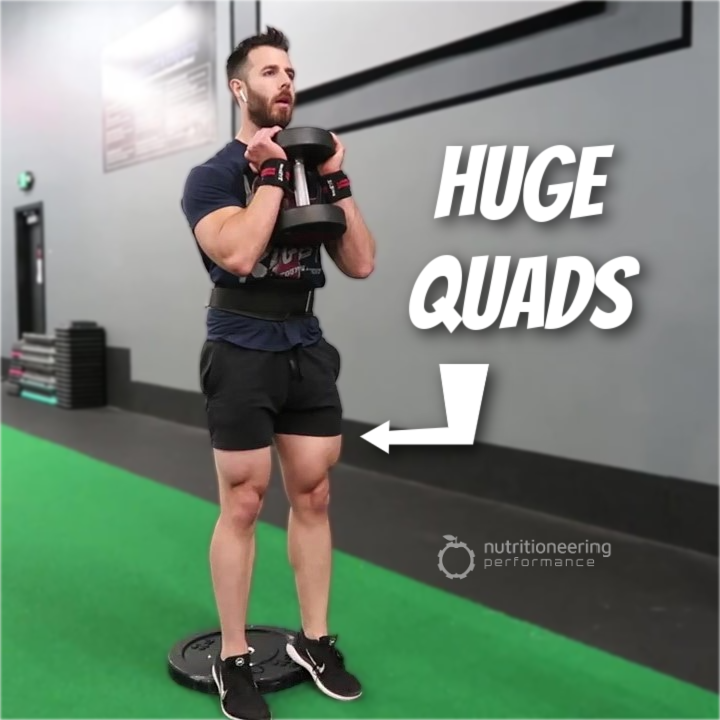
Why? Because I’m not just squatting for the sake of squatting—I’m training to build bigger quads.
And after years of experimentation, I’ve found that heel-elevated goblet squats are one of the most effective, efficient ways to target my quads with minimal lower back fatigue and maximum mind-muscle connection.
In this post, I’ll break down why I use this variation, how it changes the mechanics of the movement, and how it might benefit you if your goal is to build stronger, more muscular legs.
What Makes the Goblet Squat So Effective?
Let’s start with the basics. The goblet squat is a front-loaded squat variation where you hold a dumbbell or kettlebell at chest level. Holding the weight in front naturally encourages a more upright torso, shifting your center of gravity slightly forward compared to a back squat.
This upright posture makes the goblet squat ideal for emphasizing knee flexion over hip hinge—meaning it already leans into being a quad-dominant movement.
But if you’re trying to truly dial in on the quads, especially as a bodybuilder, there’s a simple tweak that takes the movement to another level: elevating your heels.
Why I Elevate My Heels on Goblet Squats (A Bodybuilder’s Perspective)
The main reason I elevate my heels is to induce a deeper knee bend, which puts the quads under greater tension through a larger range of motion—exactly what I’m after for hypertrophy.
I’m average height but have relatively long legs and a shorter torso. These body proportions make it harder to maintain an upright posture when squatting.
Elevating the heels also:
- Reduces the ankle mobility demands
- Allows for a deeper squat, even for taller lifters
- Encourages an even more upright torso
- Makes it easier to “sit between your heels” instead of folding at the hips
For me, the heel-elevated variation creates a much stronger quad pump and burn compared to flat-footed squats—without needing as much external load.
Flat-Footed vs. Heel-Elevated: Body Mechanics Compared
As a certified personal trainer, I knew how elevating your heels affects squat form.
But it wasn’t until I filmed exercise tutorials for both the flat-footed and heel-elevated goblet squat variations that the differences really became apparent.
Here are still shots from the bottom of the range of motion for each exercise so you can see the difference.

Even though the exercise looks similar on the surface, the body mechanics are completely different. Here’s what’s going on under the hood:
| Flat-Footed | Heel-Elevated | |
|---|---|---|
| Torso Angle | Slight forward lean | More upright |
| Knee Travel | Limited by ankle mobility | Greater forward travel, deeper knee bend |
| Range of Motion | Often restricted | Increased depth |
| Muscles Worked | Shared between quads, glutes, hamstrings | Quad-dominant |
Once I saw the side-by-side video footage, it was obvious that elevating my heels drastically improved my goblet squat depth—so much so that it’s been my default setup ever since.
I also created a short comparison video showing flat-footed vs. heel-elevated goblet squats side-by-side so you can see the difference in motion.
But Aren’t Goblet Squats for Beginners?
Some seasoned lifters look down on goblet squats as an inferior movement. Their main complaint is that the loading is limited by how much weight you can hold in front of your chest. Whereas your legs are the bottleneck on back squats.
However, the power of heel elevating is that you don’t need super heavy weights to get serious quad activation.
In fact, I’ve found that heel-elevated goblet squats outperform barbell back squats in certain situations—especially for lifters who:
- Have long femurs or poor ankle mobility
- Struggle to feel their quads during squats
- Want to limit lower back fatigue
- Train at home with limited equipment
Don’t get me wrong, it’s absolutely not a replacement for barbell squats—but it is one of the smartest quad-specific tools in my arsenal.
Is Heel Elevation Cheating?
Not at all.
There’s a misconception that heel elevation is a crutch—something you use only if you “can’t squat properly.“ But from a bodybuilding perspective, it’s a strategy, not a workaround.
If I can manipulate my stance to better target the muscles I want to develop, I’m going to do it. Period.
Tips for Maximizing the Heel-Elevated Goblet Squat
Here’s how I set it up for maximum benefit:
- Heel elevation: I use weight plates, but dedicated squat wedges work, too. 1–2 inches of elevation is usually ideal.
- Foot stance: Slightly narrower than shoulder-width, feet pointing slightly outward.
- Grip: Keep the dumbbell tight to your chest. Let your elbows point almost straight down, not out.
- Cueing: Think “hips down, knees forward, chest tall.” Sit between your heels—not back like a hip hinge.
- Tempo: Try slow eccentrics (3–4 seconds down) or pause reps at the bottom to increase time under tension.
- Progression: When 12–15 reps feel easy, increase dumbbell weight, time under tension, or total volume.
And here’s my under-1-minute instructional video breaking down proper setup and form.
My YouTube channel has dozens of videos showing you how to do a variety of bodybuilding exercises. You’ll learn how to target and build specific muscle groups in 90 seconds or less. Click HERE to subscribe, or click on the button below!
Final Thoughts: Elevate with Purpose
The heel-elevated goblet squat is more than just a mobility workaround—it’s a focused tool for building your quads.
If you’ve struggled to feel your quads during leg day, or if barbell squats leave your back fried but your legs under-stimulated, give this variation a shot. You might be surprised at how effective it can be.
Try This in Your Next Workout
Add 3–4 sets of heel-elevated goblet squats to your next leg day, aiming for 10–15 reps. Focus on control, depth, and quad tension—not just moving the weight.
And if you’re interested in how other squat variations affect muscle emphasis, check out this in-depth post:
👉 High Bar vs. Low Bar Squat: Which Is Better for You?
It’s the perfect companion to this article if you’re serious about optimizing your lower body training.
