
Silent Workouts Are My New Superpower
Why I’m training without music – and what changed

By: Jeremy Fox CNC, CPT
Updated: January 18, 2026

My workouts start at 5 am, long before the rest of the house wakes up. It’s just me, the weights, and my music before work and family responsibilities take over.
But during the holidays, that routine changed.
My wife’s parents were staying in our guest room, within earshot of the basement gym. Out of courtesy, I left my Bluetooth speaker off.
No music. No background noise at all.
I expected the workout to feel flat. Boring, even. Instead, something else happened.
That morning was a breakthrough, not because I had my best workout, but because my awareness changed.
I was shocked that what you listen to can have such a tangible impact on training.
That’s why I’m sharing the practical gains I experienced from working out in silence.

Photo of author (me) in my home gym.
The Sounds of Silence
For years, audio has been part of my training.
Since my teenage powerlifting days, I’ve listened to heavy metal to psych myself up for intense lifts. I still put on The Sickness to grind out heavy squats.
Music functions as a motivator. The beat sets the tempo. Lyrics and melodies amp up the energy.
If I’m not listening to music, I tune up a podcast for “productive” multitasking. As a busy dad, I justify it as efficiency, learning something while I train. Killing two birds with one stone, right?
Silence showed me something. It removed the illusions that audio added intensity or productivity to my workouts.
In hindsight, listening to informative podcasts robbed my workout efficiency. Thinking about ideas, arguments, or stories took up cognitive bandwidth, leaving less for the task at hand.
Music does the same thing, just more subtly. It numbs the pain of a hard set. The noise drowns out the discomfort.
Without audio pulling my attention outward, I snapped inward. That’s where the transformation happened.
Play It By Ear
My first silent workout was leg day featuring barbell back squats — the one exercise where I rely on loud, angry, or inspiring music to get me through.
Needless to say, I wasn’t sure how it would go.
Much to my surprise, silent squats were not the torturous task I expected. The reason, I believe, was breathing.
Doing heavy squats in my home gym (with music).
During this workout, my breathing was the only sound in the room. It was impossible to ignore.
Almost immediately, my breaths became slower. More deliberate.
Inhales were deeper through my diaphragm instead of rising into my chest. Exhales were powerful and perfectly timed with the ascent.
The eccentric and concentric phases of each rep started to sync naturally with my breathing rhythm.
With music playing, breathing had become an afterthought. Something that happened in the background while I focused on getting through the set. In silence, it became the anchor.
By focusing on my breath, I controlled my response to stress. That sense of control carried over into the rest of the workout.
It was the first clear sign that training in silence wasn’t a limitation. It was an advantage.
Strong, Silent Type
Once my breathing fell into place, the next distinctive change was that my focus moved inward.
As a bodybuilder, this matters.
Hypertrophy isn’t just about lifting heavy weights. It’s about creating tension in the target muscle. That requires a particular kind of attention, called the mind-muscle connection.

Without music pulling my attention outward, I became far more aware of what my body was actually doing. Instead of just moving the weight from point A to point B, I could better focus on contracting the right muscles.
Hitting pause on the playlist improved my mind–muscle connection immediately.
As with my breathing, each rep slowed down. Each contraction became more deliberate.
Instead of thinking “move”, I was thinking “squeeze”.
Internal vs External Focus
Empirical research supports the idea that this type of internal focus during resistance training can significantly enhance muscle activation.
For example, a 2018 randomized controlled trial demonstrated that lifters who used an internal focus achieved almost twice the gains in muscle size compared to those who used external focus.
That said, the story isn’t as simple as “internal focus is always better.”
External focus, like concentrating on explosively moving the bar, has been shown to increase the force athletes produce during exercises. For Olympic lifters and other athletes, relying on these external cues is more effective because it reduces the mental effort required, allowing them to perform more complex movements automatically and with less conscious thought.
In other words, both types of focus have their place.
What silence did for me was remove competition for attention. Without audio stimulation, I could choose where my focus went rather than have it hijacked.
For my fitness goals, that’s powerful. A higher degree of internal focus allows me to train with intention rather than on autopilot.
Quiet Time
For the last 5 years, I’ve used a stopwatch app to time my rest periods between sets. That part of my routine stayed the same. What changed was everything that happened within those rest periods.
Training in silence resulted in less time wasted between sets. Without even trying, I shaved 2 — 3 minutes off my average workout duration.
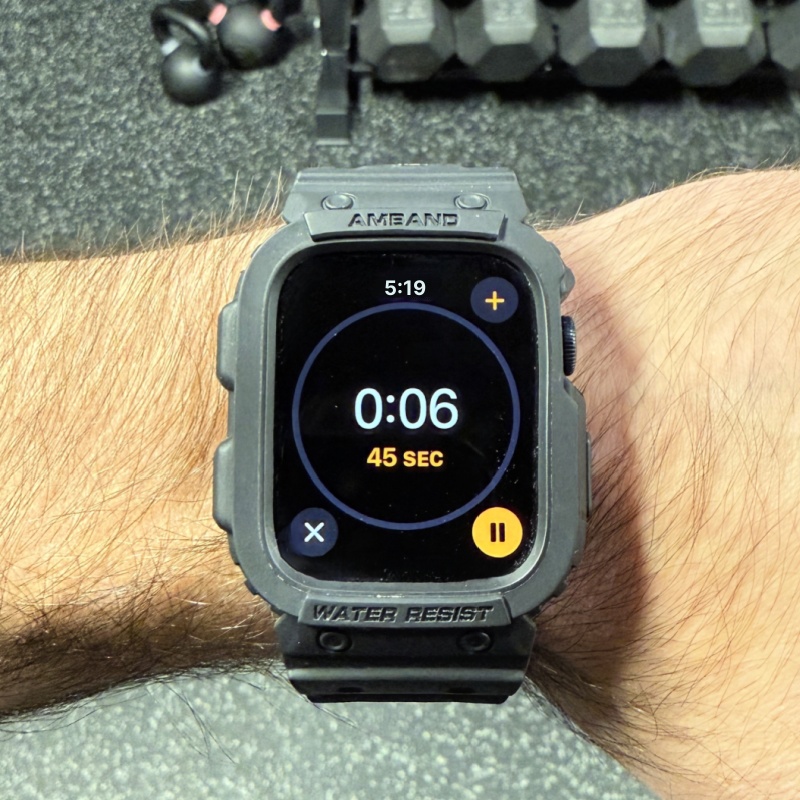
Using an app on my watch to time rest periods. For these short workouts, I take 30 to 60 second breaks, depending on the exercise.
That may not sound like much until you consider that my morning sessions last just 20 to 30 minutes. So even a few minutes is a substantial 10-15% time savings simply by turning off the speaker.
With music playing, I didn’t realize how often my attention drifted once the timer went off.
- A song would end, and I’d hit “next” until another suitable option came on.
- A podcast segment would hook me, and I’d sit and listen for a minute.
- Or a random thought had me off in la-la land.
None of that felt wasteful at the time. But once the audio was gone, the suboptimization was obvious.
In silence, when the timer beeped, I was ready to start the next set. Don’t get me wrong, I can still get caught up daydreaming about a work project or my next Medium story. But now nothing actively pulls my attention elsewhere.
More importantly, those minutes didn’t come from rushing reps or cutting sets. They came from eliminating dead space.
I filled that space by setting up the next exercise, reducing time spent changing machine settings or loading weights. Silence made my workouts more compact. It increased training density.
For someone training early in the morning, juggling work and family responsibilities, that’s a big deal. Efficient workouts aren’t about doing less; they’re about removing what doesn’t serve a purpose.
Pressing “power off” on my speaker was like an easy button for workout efficiency.
Suffering In Silence
Once my workouts got shorter, they naturally felt harder.
Not harder in the sense of adding weight or reps, but harder because I did the same work in less time.

This equation illustrates how intensity can increase when weight x reps x sets increase OR when the time spent performing that work decreases.
By the middle of most sets, fatigue was already setting in. The kind of tired that focused effort instead of simply banging out reps.
By mid-week, the physical feedback reflected that change. Most noticeably in the form of increased muscle soreness.
I wasn’t shocking my muscles with a new exercise or more forced reps. So I took that soreness as a sign of workout quality over quantity.
This lagging indicator solidified that removing music didn’t negatively affect my training. Actually, it may have provided a boost.
Doing squats in dead silence forced me to confront the physical and mental challenge head-on. Leaning into discomfort rather than escaping it felt like a form of mental training on top of the physical workout. Not unlike an ice bath, where your brain is telling you to get out the entire time.
Silence quietly alters the training equation. It doesn’t rely on adrenaline. Instead, it fosters discipline, something you can learn to harness and use when life gets tough.
The result wasn’t a louder or longer workout. It was a more challenging one. And that’s what leads to progress.
Quietly Making Gains
My gym performance shifted in ways that revealed how closely strength is tied to breathing, tempo, and focus.
I log all my workouts the old fashioned way — with pencil and paper. So I was able to go back and see if anything changed.
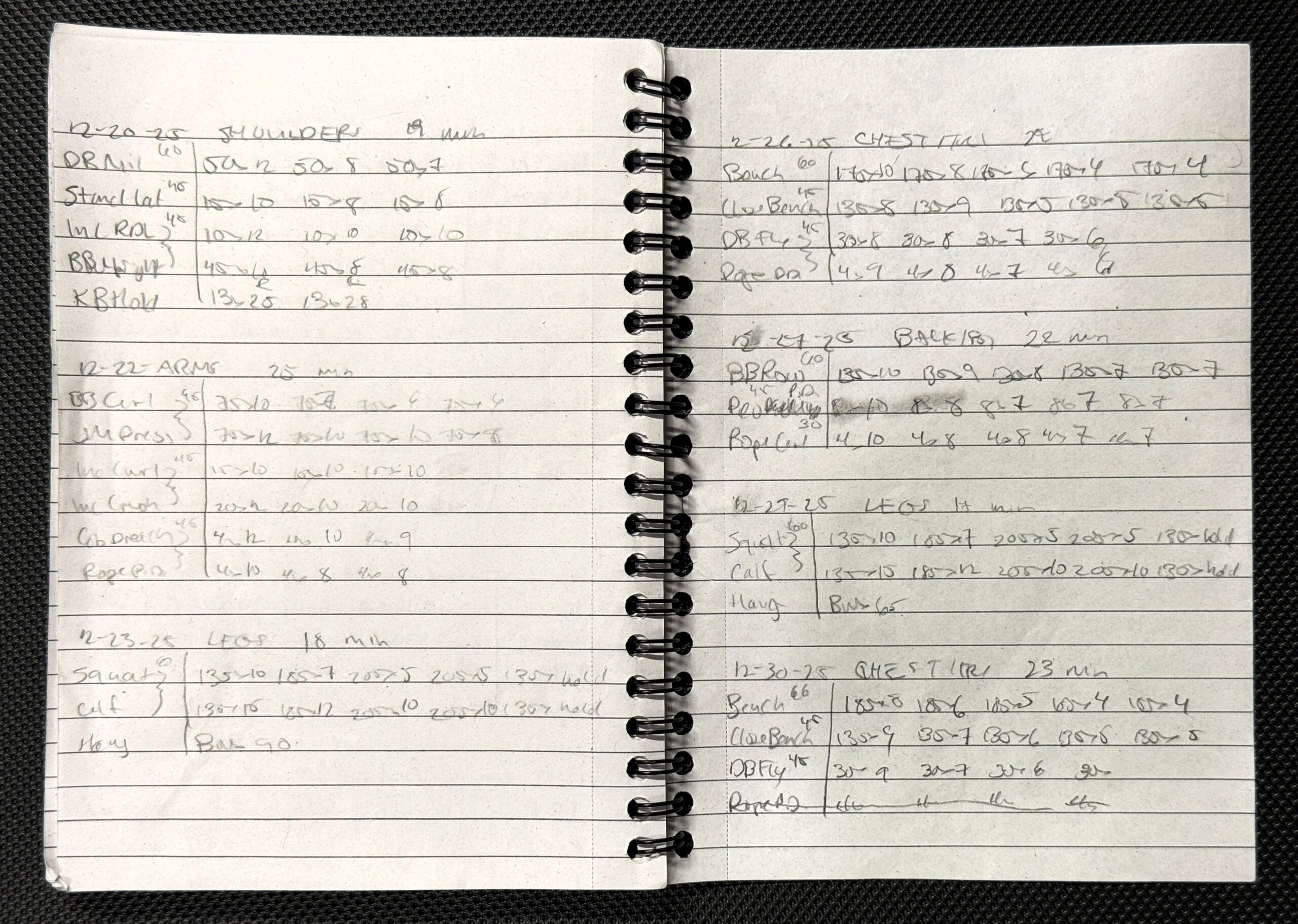
A photo of my workout log from the week I started silent workouts. If you can’t read it, that’s ok. I’ve compiled some of the key numbers below.
One outlier was the pull-up bar static hang, which drastically improved. My hang time increased from 75 seconds to 90 seconds — a new personal best.
On other exercises, my rep counts actually decreased that first week. I don’t think that was a regression or a lack of motivation. The weights stayed the same, but the reps were slower and more controlled, resulting in more time under tension.
The major compound movements, like squats, bench press, and barbell rows, all followed a pattern. Despite the slower tempo and increased focus, my strength held steady.
I attribute this to the central role of diaphragmatic breathing in multi-joint lifts. With no music, it became easier to brace properly, breathe deeper, and stay calm under load.
After that first week, my strength actually started improving.
Now, one month later, I’m doing more weight and/or more reps on many exercises even without audio.
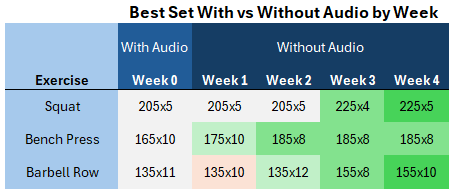
My strength progress after 1 month of silent workouts (weight x reps).
Before this experiment my strength had declined due to sleep deprivation (a growing baby will keep you up at night). So the fact that I’m getting stronger now is a testament to the recent change in acoustics.
More importantly, each rep is more challenging for the target muscle because I’m focused on my body, not the background.
From a bodybuilding standpoint, this is an ideal form of progressive overload for long-term muscle growth.
Changing My Tune
None of this is an argument that music is “bad” or that everyone should train in silence all the time.
In some environments, headphones and music are almost a necessity. Commercial gyms are full of distractions like clanging plates, conversations, and today’s top 40.
In those overstimulating settings, music serves a different purpose. Instead of stealing your attention, it can act as a buffer, blocking disturbances and creating a controlled environment.
Sometimes a familiar playlist can help you stay focused and train more effectively.
Music can also be useful during:
- Max effort or near-maximal lifts
- Olympic or powerlifting training sessions
- Running or cycling workouts
- When motivation is the limiting factor rather than technique
There’s nothing wrong with using music as a training tool. The key factor is whether it enhances your workouts or gets in the way.
If music helps you stay engaged and show up consistently, it’s serving a purpose. If it becomes a crutch or an interruption, it may be worth reassessing.
What silent training taught me was not that music must be avoided. It was that attention should be prioritized.
Silence simply removes variables. Music reintroduces them. Used deliberately, both have a place.
Silence Is Golden
I didn’t set out to reinvent my training.
The shift to silent workouts stemmed from not wanting to wake my in-laws before dawn. What I didn’t expect was how that constraint revealed something I’d been missing.
Training without music stripped my workouts down to their essentials — breath, intention, effort.
Here’s a recap of my silent workout transformation:
- A newfound awareness translated to more effective breathing and a stronger connection to the working muscles.
- My sessions became shorter but more demanding.
- Initially, my numbers stayed mostly the same. Within a few weeks, strength and endurance went up.
That doesn’t mean I’ve sworn off music forever. What changed for me is that silence is now an option.
Training without the aid of sound isn’t about being stoic or minimalist (although I am a man of few possessions). It’s about seeing what happens when your attention is fully directed towards one task. For me, it unlocked a level of concentration I had never experienced in my workouts.
Audio became a factor in an impromptu performance experiment. Analyzing the data changed how I think about working out.
I continue to train this way because it works for my goals right now. But more importantly, it expanded my understanding of how attention shapes fitness outcomes.
If you’ve never lifted in silence, I’d encourage you to try it, even if just for a session or two. Leave the headphones at home. Listen to your breathing. Pay attention to your muscles.
You might find, as I did, that training without audio is a superpower you didn’t know you had.
And once you’re aware of it, silence becomes another tool in your training toolbelt. One you can use when the situation calls for it.
More Training & Nutrition Experiments
If you liked this article, I know you’ll like these other insightful personal fitness experiments.
I Stopped Tracking Calories Without Losing My 6-Pack