
A Nutritionist’s Guide to Tracking Macros Without Losing Your Mind

By: Jeremy Fox CNC, CPT
Updated: May 26, 2025

If you’ve ever tried tracking macros, you’ve probably dealt with:
- The frustration of checking every food label.
- The endless math of grams and percentages.
- The mental gymnastics of trying to hit your numbers without going over.
I get it. As a certified nutrition coach, I’ve worked with plenty of clients who started out thinking macro tracking was too time-consuming or too complicated to stick with. And hey—I’ve felt that way myself in the beginning. But here’s the good news:
Tracking macros doesn’t have to take over your life.
With a little guidance, the right tools, and a mindset shift away from perfectionism, you can start using macros to feel more in control of your nutrition.
In this article, I’ll walk you through exactly how to track macros without burning out.
What Are Macros—and Why Should You Care?
Macros (short for macronutrients) are the three main nutrients your body needs in large amounts:
- Protein – Helps build and maintain muscle
- Carbohydrates – Your body’s primary source of energy
- Fat – Essential for hormones, brain function, and overall health
Every food you eat is made up of some combination of these three macros, measured in grams.
Each gram has a set number of calories – 1 gram of fat has 9 calories, while 1 gram of protein or carbohydrate has only 4. So by tracking macros, you’re also tracking calories.
While calories tell you how much energy you’re eating, macros tell you what kind of energy it is.
Think of it this way:
Calories are your body’s utility bill. Macros are how much you spend on electricity, gas, and water.
If you wanted to save money on utilities, you would review each line item on your bill to see where you’re spending the most.
In the same way, understanding macros allows you to itemize your diet to support your goals, whether that’s building muscle, shedding body fat, or just having more energy throughout the day.

Step 1: Find Your Calorie and Macro Targets
Before you can track macros, you need to know what your targets are.
Some people set their macro targets based on body weight, such as 1 gram of protein per pound. This can be a simple starting point, but it’s not always accurate.
Calorie Needs
In my experience, it’s better to start with calorie needs and then calculate macros as a percentage of those calories.
This approach considers your:
- Body weight and composition
- Activity level and exercise
- Fitness goals (fat loss, maintenance, muscle gain)
- Personal preferences (like low-carb vs. balanced)
Your body weight and composition primarily contribute to your basal metabolic rate (BMR). While your daily activity and exercise habits add to BMR for your total daily energy expenditure (TDEE).
You could think of TDEE as your maintenance calorie target. And you need to adjust it up or down to create a surplus for muscle gain or a deficit for fat loss.
Macronutrient Ratios
Once you know your daily caloric needs, you can allocate percentages to each macronutrient.
A common starting point is 40% carbohydrates, 30% fat, and 30% protein, also know as the 40-30-30 diet. But you can adjust these ratios based on your specific needs.
Here are common macro ratios I use with my clients:
- Keto = 5% carbs, 70% fat, 25% protein
- Low Carb = 20% carbs, 50% fat, 30% protein
- High Protein = 40% carbs, 25% fat, 35% protein
- Balanced = 50% carbs, 25% fat, 25% protein
- High Carb = 60% carbs, 20% fat, 20% protein
Once you choose your percentages, you can easily determine your macro targets in grams.
Example Calorie & Macro Targets
I can already see some of you falling asleep in the back row. So, to make things more interesting, let’s consider a real-world example.
Joe has determined that he needs to eat 1,900 calories per day to lose weight. And he wants to try a low-carb diet (20-50-30).
To find his macro targets in grams, we multiply by the ratio and divide by the calories per gram for that macronutrient.
Here are his calorie and macro targets:
- Calories: 1,900/day
- Carbs: 1,900 x 0.2 / 4 = 95g
- Fat: 1,900 x 0.5 / 9 = 106g
- Protein: 1,900 x 0.3 / 4 = 143g
Joe’s plan creates a slight calorie deficit for weight loss, and the low-carb intake helps his body become better at burning fat for fuel. At the same time, the high protein intake supports muscle retention.
Your numbers will likely be different, but this gives you a ballpark idea of where to start.
I use complex formulas with coaching clients, but you don’t need to calculate everything by hand. You can use my free Macro Calculator to instantly get your personalized targets for calories, protein, carbs, and fat.

Step 2: Choose Your Tracking Method
Now that you’ve got your numbers, how do you actually track your macros?
Here are your options:
- Macro-tracking apps (like MyFitnessPal, Cronometer, or MacrosFirst): Best for people who like visual feedback and logging on their phone.
- Spreadsheet or written log: Best for analytical minds or those who want minimal screen time.
- Pre-calculated meal plan: Best for people who want to skip tracking altogether (more on this at the end!).
I personally use an app when I need precision, but the best method is the one you’ll stick with.
If you’re just starting out, try logging your meals for 3–5 days to get a feel for your habits. It’s often eye-opening to see where hidden calories or imbalanced macros are sneaking in.
Step 3: Start Logging
Here’s where most people give up: the actual logging process. It feels tedious at first—but I promise it gets easier. And you don’t have to be perfect.
Manual Macro Tracking
One way to track your macros is to check nutrition labels and write down the grams of carbohydrates, fat, and protein in each meal. Then, tally the grams of each macronutrient at the end of the day to get your total.
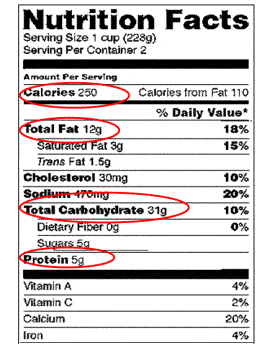
The traditional food log requires some math if you consume anything other than the serving suggestion on the label. And tracking macros by hand can take a long time.
Fortunately, modern apps allow you to set your macro targets and quickly log nutrition information.
Macro Tracking With Apps
With most macro tracking apps, you can search the food database or scan a barcode to see the macros and nutrition information.
Once you log the food, you can select the serving size and number of servings.


Repeat this step for each food you eat throughout the day while monitoring your total macros. At the end of the day, your total should come close to your goal.
In this example, my macro targets were 203 grams of protein, 270 grams of carbs, and 90 grams of fat.

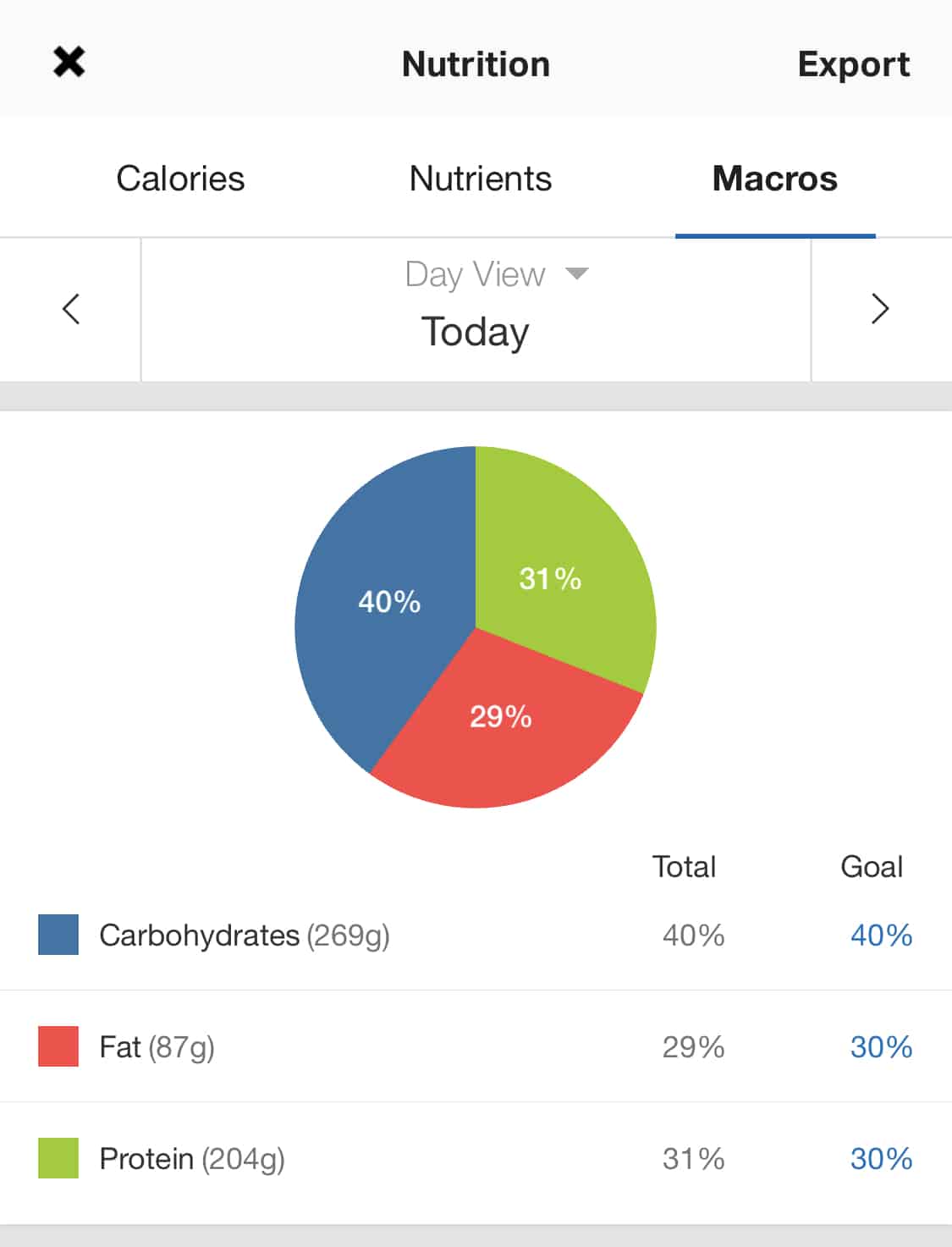
You can also see a breakdown of your macros as a percentage of total calories. In this case, my targets were 40% carbs, 30% protein, and 30% fat.
Full disclosure: I don’t always hit my macro targets within +/-2 grams, and that’s okay! This is about the process, not perfection. So give yourself some grace and keep practicing.
Here’s how to make macro tracking manageable:
- Start with what you know. Use barcode scanning or recent meals to log your staples.
- Pre-log your day. Spend 5 minutes planning your meals in advance to hit your macro targets without last-minute panic.
- Use saved meals or recipes. If you eat the same breakfast often (like my higher-protein Kodiak pancake recipe), save it and reuse it.
- When eating out, estimate. Look up similar meals or use a restaurant’s nutrition info as a guide. Close is good enough.
I tell my clients this all the time: Consistency beats precision. It’s better to be 80% accurate every day than 100% accurate for three days and give up.
Step 4: Make Adjustments and Stay Flexible
Macro tracking isn’t a rigid contract—it’s a flexible tool. You’re not failing if you don’t hit your numbers exactly.
The screenshot below illustrates a typical week for me. Notice the variation from day to day?

However, my weekly macro averages were reasonably close to the target, which was good enough to move me closer to my fitness goal.
What to do if:
- You go over on fat or carbs? Adjust your next meal, or just move on. It’s one day.
- You’re always low on protein? Add a scoop of protein powder, 1/2 cup of Greek yogurt, or a few ounces of lean meat.
- You’re hungry all the time? You may need to tweak your macro balance—or switch to higher-volume foods like veggies or rice cakes.
Tracking macros is about learning from patterns. If you’re tired, hungry, or not seeing results, your log can help you spot what’s missing—and make smarter choices without guessing.
Bonus Tips to Make Macro Tracking Easier
Over the years, I’ve picked up some tricks that make macro tracking more sustainable. Here are a few you can use right away:
- Build “macro-friendly” meals using go-to foods that help you hit your numbers fast (egg whites, oats, avocado, rice, lean ground turkey, etc.).
- Batch cook macro-balanced meals and portion them out to avoid decision fatigue and save meal prep time.
- Don’t fear “boring” meals. Repeating meals makes tracking way easier. Variety can come later.
Final Thoughts: Use Macros as a Tool, Not a Test
Tracking macros doesn’t mean obsessing over numbers. It means learning how to fuel your body better.
You might hit your targets perfectly some days and be way off on others—and that’s okay. Progress comes from showing up consistently, not hitting the bullseye every single time.
I’ve seen clients go from overwhelmed and frustrated to confident and in control simply by approaching macro tracking with a growth mindset instead of a fixed expectation.
You don’t have to lose your mind—you just have to start!
Want to Skip the Tracking Altogether?
If tracking macros still feels like too much right now, I’ve got you covered.
I created a macro-based meal plan that does all the heavy lifting for you. Every meal is designed to fit your personalized macro targets—no tracking required. It’s the exact system I use with clients who want results without logging every bite.